
Meet our members: Huw Jones, Bryn Farm, West Wales
Fourth generation farmer Huw Jones farms beef at Bryn Farm, Ferwig, West Wales, alongside wife Meinir.
The farm is 100ha with 40ha of grazing for 100 suckler cows. They also run three holiday rentals on the site.
Huw began experimenting with direct drilling in 2008/9 to improve soil health for the arable crops he grew at that time. The whole farming operation is now focused on producing beef on a pasture-based system using mob grazing.
Soil health mentoring from Regenerate Outcomes
“I first heard about Regenerate Outcomes through one of the grazing groups I am a member of and it appealed to me to get some mentoring alongside the opportunity to baseline and measure our soil carbon,” says Huw.
“Kyle from the mentoring team came out to visit and he has been really helpful so far.
“When you get started with this type of farming there is no handbook to tell you how to do everything, but sometimes you’ve just got to try things and make mistakes and learn.
“It can make a big difference to have someone to talk to and ask questions as you go through that process.
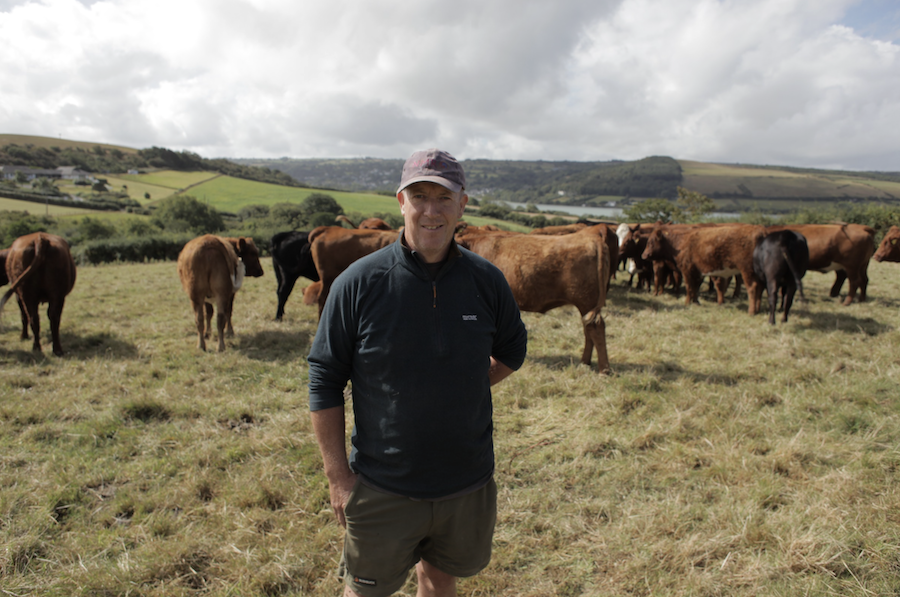
Huw Jones at Bryn Farm
“It takes time to get a baseline and if you don’t start now you never will. Hopefully, it will mean we can be ahead of the game to create another income stream. If that is the way we can be rewarded for farming in this way then so be it.
“It is also just good practice to measure your soil carbon - and all the other factors - so we can get a clear picture of the effect all of our activities are having.
“We know it must be doing the soil good growing the roots deeper and using less fertiliser. But if we get a baseline now and then have it re-measured in five years, it will let me know how much difference it is making.
“There is the potential for some financial gain from selling the carbon credits but it will also just support our good practice.”
‘We knew we had to do something’
Huw began experimenting with different techniques to improve soil health over 15 years ago, after noticing a decline in the arable fields he had at the time.
“We were growing a fair bit of arable and I could see the lighter land on one side of the farm was suffering from the ploughing and combi drilling,” he says.
“It didn’t matter how much muck we threw in there, we would have the sand shifting in the spring and soil erosion to the point where it would drift into the hedges like snow. We knew we had to do something to stop this.
“We went to visit a farm in Pembrokeshire and then another in Brecon and I thought if they can direct drill cereals in the hills of the Brecon Beacons then I can do it here. I bought a secondhand direct drill and began putting all of my crops in like that.
“Because my rotation was pretty simple - we just had corn, a green crop and grass - the drill could handle everything. It immediately cured the sand shift problem in the first year and we started to build the organic matter in the top few inches.

Agricarbon taking soil cores for Regenerate Outcomes at Bryn’s farm.
“We carried on direct drilling and putting in cover crops and green cropping in the winter for years. In 2018 I attended a Master Grass event run by Farming Connect in Wales and I began to learn about rotational grazing and how you put in the infrastructure for the electric fencing and the water.
“We put the infrastructure in in late 2018 and started doing the shorter rotations in late 2019. We were able to stop using fertiliser on our grazing platform from then on and allow it to regenerate naturally and put its own roots down and harvest what is there.
“We made sure that our P and K and PH levels were OK and we had to dress a little bit of lime in some places, but not really much. Once you get to a certain level it seems to look after itself. Now we haven’t bought any P and K for 15 years.
Outwintering to maximise profits
“We have been outwintering the cattle for years now and putting green crops in after cereals. In the latter years we have been supplementing the outwintering with hay bales or silage bales to make the field last a lot longer. The dry matter in green crops is low so we supplement with bales to extend the time they can be out.
“I have them in three groups of about 30 in a group and I move them every day, just a strip of perhaps two or three metres and then a bale of hay. It’s such a financial gain instead of having them in a shed. It’s a game-changer.
“Two years ago we decided to pick some light fields and establish a permanent outwintering block. I had Cotswold Seeds make a grass mixture for me which was suitable for making hay and I have made 500 bales of hay this year.
“They are made in the fields where they will be used and placed in situ ready for the winter in the hedges. We are going to move this year from using round feeders to rolling them out. We were getting damage last year around the ring feeders to the point where we had to cultivate and re-seed. I want to avoid that this year.

Huw and his herd
“Once the cows get used to bale grazing they eat it straight away. They get a strip of fresh grass every day in the winter which they go for first and then I unwind the bale on yesterday’s grazing. The hay is full of seed and so they naturally spread it out and it is self-seeding.
“After they’ve finished the outwintering they will then calve outside. I’ve changed my bulls to Stabilisers this year so there will be no calving inside. They will use the same system on fresh grass and a bale. We will move them onto the grazing platform in April when the covers are high.
“This year it went dry in May and June and I did think about cutting and making hay because I had such an excess of grass in those months. But I knew, on a dry farm like mine, if we didn’t get any more rain then I would just end up feeding those bales straight back.
“So I made the decision to graze the tall pastures and that worked really well. The only mistake I made was that I should have left more cover because it stayed dry. Instead of grazing it down to, say, 1600 like I normally do, I should have left it at 1900 or 2000, so you get more soil coverage to keep the heat out of the ground and you’ve got more leaves to drive the regrowth.
“At calving you can see there is much more mobility in the cows because they are walking a lot more than they would be in the shed. In the past I have lost calves through heifers lying on them in the shed but that doesn’t happen outside because there is more room. There are all sorts of benefits you wouldn’t necessarily think about.
“We don’t vaccinate. The only thing we use pre-calving is a mineral bolus and I will Ivomec the calves, but otherwise my vet bill is pretty small.”
Regenerate Outcomes works with
farmers to grow profits
We provide one-to-one mentoring to help you cut costs and improve crop and livestock performance.
At the same time, we baseline and measure soil carbon at no upfront cost to generate carbon credits which you can retain or sell for additional income.
Find out more by downloading our Programme Handbook.