
Grounded ‘Live’: Machinery and equipment in regenerative agriculture
In January’s recording for Grounded ‘Live’ we brought together a panel of Regenerate Outcomes member farmers to discuss machinery and equipment used to implement regenerative practices.
Kyle Richardville and Stuart Johnson, from our mentoring team, were joined by Verity Megginson, who farms arable and sheep in East Yorkshire, cattle, sheep and arable farmer Tom Fairfax, from Northumberland, and Rhy Jones, who manages an arable farm near Cambridge.
The conversation covered everything from electric fencing, solar energisers and water infrastructure to pumps, tree guards, direct drillers, bale unwinders and more.
You can watch the full video of the recording below or listen to it as a podcast here.
Verity farms the 300 acre Kirkburn Manor Farm, in East Yorkshire. She began farming conventionally, but has been taking a more regenerative approach in recent years, which has included adding sheep into the rotation.
Tom’s family bought Mindrum Farm in the 1950s and it is now an organic, mixed farm, using a mob-grazing system for cattle, which are outside for as much of the year as possible.
Rhys manages Manor Farm, at Caxton, near Cambridge. Over the last 10 years the farm has been introducing practices such as direct drilling and integrating sheep, as well as reducing the use of chemical inputs.
A few top tips on equipment for regenerative agriculture
Soil biology is key:
For Verity, part of the regenerative process has involved low disturbance subsoiling across the farm.
However, she warns that such actions will only be effective if the necessary diversity of plant life and roots structures are also introduced to fire up the soil biology.
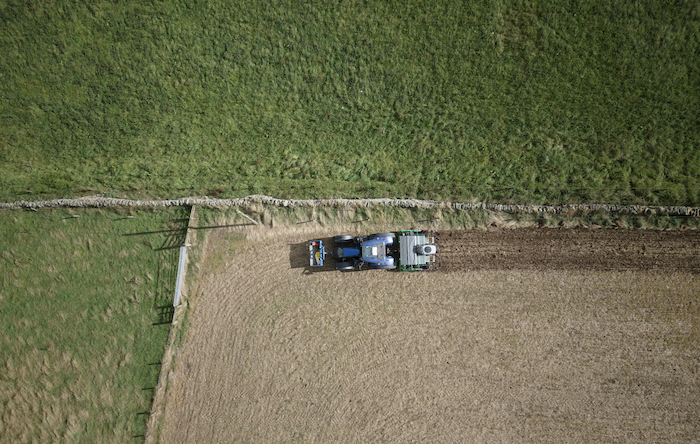
. Direct drilling on a farm in Northumberland
“You can’t just put a hunk of metal in the ground to achieve what you want to achieve,” she says.
“We did need that reset, but it will only then work if you can follow it up with the roots and the biology within the soil.”
Reducing impact on the ground:
Tom has begun using the lighter Kawasaki MULES, instead of Landrovers, because of their reduced impact on the ground, this in addition to investing in bale unrollers for bale grazing, which causes far less damage than using ring feeders.
Buy cheap, buy twice:
Stuart says when it comes to electric fencing for mob-grazing, it makes sense to invest in the best equipment you can.
“I am a big advocate that if you are going to spend money on electric fencing, buy properly the first time and get it right,” he says.
“I am a big advocate that if you are going to spend money on electric fencing, buy properly the first time and get it right.”
“When I first began I bought the cheapest ungeared reels I could because it was cheap, but unfortunately it made life very difficult and I ended up having to spend more money soon after.”
Keep water close to the animals:
Solar water pumps can work well for bringing water to cattle in the mob-grazing system to avoid them damaging the ground with repeated travel to watercourses and other sources of water.
“Keeping water to livestock is paramount so they are not trailing backwards and forwards,” says Stuart.
“If they are walking backwards and forwards across fields to get to it, that can cause a lot of damage because of the footfall.”
You can catch up with the full discussion and all the tips and advice from our panel by watching the video here or listening to the recording as a podcast.
Regenerate Outcomes works with
farmers to grow profits
We provide one-to-one mentoring to help you cut costs and improve crop and livestock performance.
At the same time, we baseline and measure soil carbon at no upfront cost to generate carbon credits which you can retain or sell for additional income.
Find out more by downloading our Programme Handbook.