
Alexander Dickinson and his wife Annabel own and run the Styford Estate, near Stocksfield, in Northumberland.
The estate consists of 700 acres of arable land and pasture, with 370 breeding ewes. About a third of the estate is made of up woodland, some of which is being converted from commercial forestry into native broadleaf species.
Away from the estate Alexander is a solicitor specialising in advising the owners of historic landed estates. He is also a former non-executive director of the Country Land and Business Association.
Farming at Styford has always been mixed, with a strong focus on continuous reinvestment and maintaining the performance and function of the land to consistently improve the estate over time.
The farmland is managed under contract by Martin Bell, who also oversees a number of other farms in the area. Martin has been adopting practices such as companion cropping and direct drilling to improve soil health, enabling the estate to reduce the number of inputs it applies each year.
‘The right thing to do.’
“For me it was clear that being part of Regenerate Outcomes was the right thing to do,” says Alexander.
“Martin has been managing the farm in a regenerative way for the last 20 years. So joining Regenerate Outcomes was really a natural progression.
“We had increasingly done less and less tilling and were focusing on improving soil health.
“I wanted our soil to be better because I knew there were lots of positive things that would come out of it. We'd have better crops. We'd have a better harvest, fewer inputs, and it would become more profitable. In turn that would allow us to invest in other things that we needed to do on the estate; so it’s a virtuous circle.
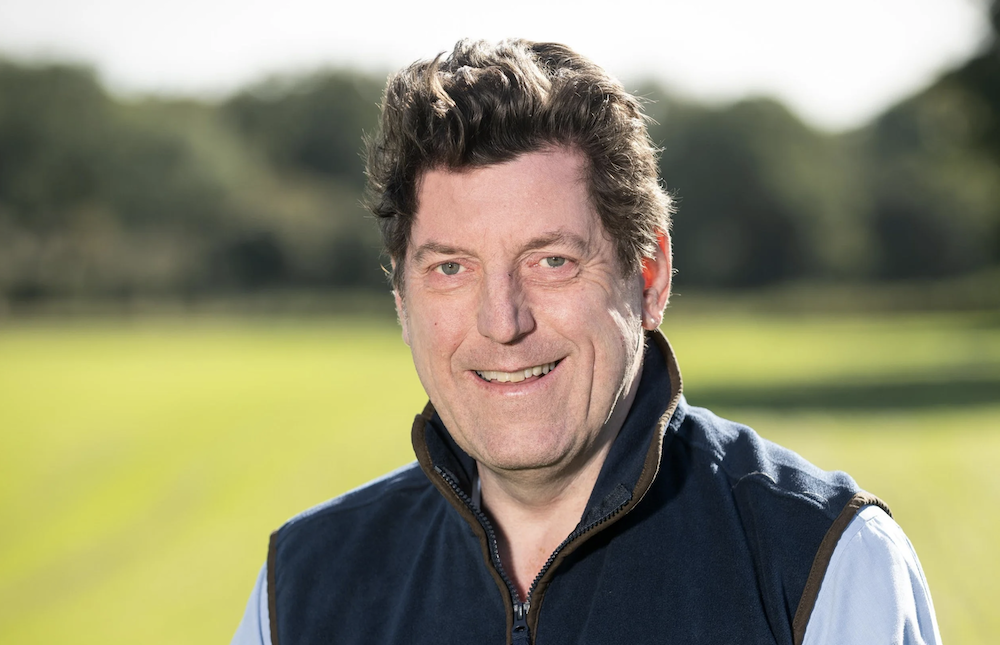
Alexander Dickinson: “Joining Regenerate Outcomes really felt like a no-risk scenario.”
“It was clear that things were changing after Brexit and looking at an alternative way to get a return on the land was attractive. There was also an attraction to being part of a movement that was new.
“I liked the people involved, I felt I could talk to them and they understood what we were trying to achieve. To me, joining Regenerate Outcomes really felt like a no-risk scenario.
“Really we are being encouraged to go a bit further down the line by Regenerate Outcomes and being offered a return for it, which hopefully we can reinvest across the estate.
“There are a number of people I talk to now who agree that this type of farming is the way forward for many in agriculture.”
“In my view you can talk about profitability in terms of your P&L, which gives you more money to plant more hedges, lay more drains or repair fences. Then there is the profitability which is harder to measure, which comes from knowing you have improved things over time.
“My job while I am here is to make Styford better than when I took it over. That’s not a one-year project or a three-year project, it’s a matter of decades.
“There are a number of people I talk to now who agree that this type of farming is the way forward for many in agriculture. I don’t think I would have been having those conversations five years ago. It has definitely become more mainstream.
“I want to do the best I can as a landowner to make this an interesting and diverse place and not a monoculture. We get a lot of pleasure from the environment we live in and knowing that we are doing the best we can for that environment.”
Regenerate Outcomes works with
farmers to grow profits
We provide one-to-one mentoring to help you cut costs and improve crop and livestock performance.
At the same time, we baseline and measure soil carbon at no upfront cost to generate carbon credits which you can retain or sell for additional income.
Find out more by downloading our Programme Handbook.