
Organic matter plays an essential part in ensuring effective water cycling. In this piece Kyle Richardville, from our mentoring team, explains some of the actions you can take to build resilience in the face of extreme weather.
Rain is only useful to a farm once it gets into the soil (writes Kyle) and stays where roots can reach it. Soil organic matter is key to both these things happening.
A rain gauge might record 25 mm overnight, but if half of that ran off into the ditch, the field really only received 12 mm. The rain gauge, in other words, can be a bit of a liar.

Kyle mentoring at a Regenerate Outcomes member farm in Northumberland.
Soil scientists use the term effective rainfall for the water that actually ends up supporting plant growth: everything that fell, minus what evaporated, ran off, or leached below the root zone. So when a neighbour asks how much rain you got after a big storm, the ideal answer is "all of it".
After two dry summers in a row, and with wet winters bringing waterlogging and runoff of their own, capturing as much of every rainfall event as possible has never mattered more to British farmers. Believe it or not, the amount of organic matter in the soil is a major determinant of water infiltration and holding-capacity.
Rock, rock, rock… and organic matter
The solid part of soil is made up of sand, silt, clay and organic matter, and the first three are simply rocks in different sizes. A soil with very little organic matter is, in effect, a growing medium of crushed rock. Each component behaves very differently with water.
Sand particles are large, with few electrical charges on their surfaces for water to cling to. They leave big pores that water drains straight through. A sandy soil is a small bucket full of holes: it can't hold much, and what it does hold is quickly lost, taking soluble nutrients such as nitrate, sulphate and boron with it.
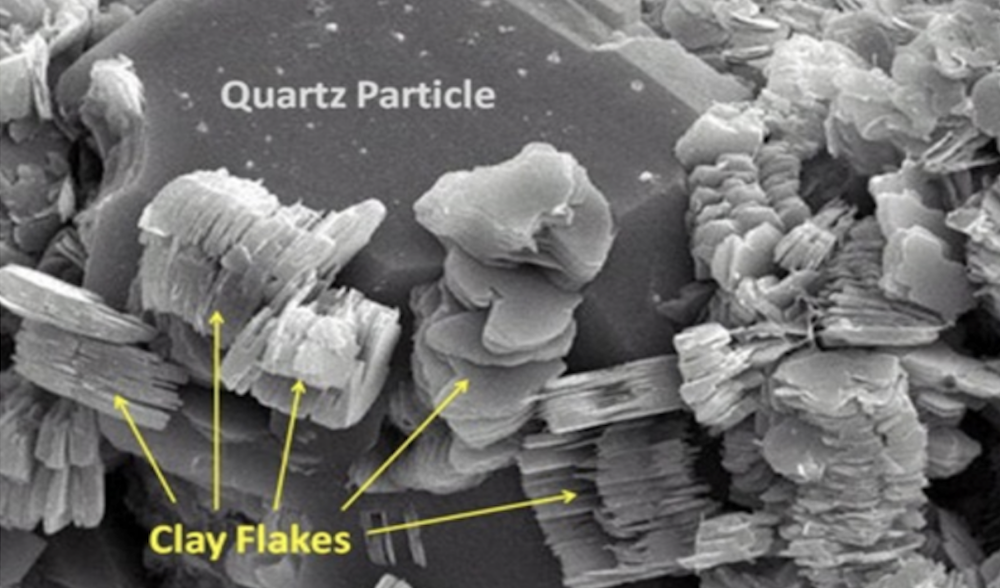
Clay particles in soil under a microscope.
Clay is the opposite. Its tiny, plate-like particles stack like the pages of a book and carry mostly negative charges, which grip water tightly. Clay is a big bucket, but much of the water it holds is bound so firmly that roots can't extract it, and water struggles to move through the profile at all.
Organic matter solves both problems. It carries even more charge than clay is far less dense, and has an enormous surface area, so it holds large amounts of water and nutrients. Crucially, it holds that water loosely, leaving much of it available to plants. If any part of the soil deserves a superhero cape when it comes to the water cycle, it's organic matter.
Getting water into the soil
Picture pouring water into two jars, one filled with gravel and one with flour. Water runs straight through the gravel but sits on top of the flour, because the fine particles leave no large pores for it to travel through. Healthy soil needs a bit of both: large macropores that let water drain in and air move, and smaller storage pores that hold water where roots can reach it.
Well-formed soil aggregates, the crumbs that make up a good soil structure, provide both at once. The gaps between aggregates act like roadside drains, letting rain in quickly, while the fine pores within them, and within the organic matter itself, store water. Even when a healthy soil is air-dried, the humidity inside its aggregates can stay at around 98%, keeping soil life active through dry periods.

“Drop a dry clod of regularly cultivated, low-organic matter soil into water and it collapses into a cloudy mess, while a clod from permanent pasture or an undisturbed hedge bottom holds together.”
Aggregates aren't built by chemistry alone; they're built by living, breathing organisms (biology). Roots and fungal threads knit particles together, and biological glues such as glomalin, produced by mycorrhizal fungi, hold them in shape when wet. Because these glues don't dissolve in water, a biologically active soil keeps its structure when the rain comes.
The slake test shows this clearly. Drop a dry clod of regularly cultivated, low-organic matter soil into water and it collapses into a cloudy mess, while a clod from permanent pasture or an undisturbed hedge bottom holds together.
In the field, that same collapse becomes surface capping: raindrops hit bare soil like small bombs, break up the surface and leave a crust that sheds the next rainfall as runoff, carrying topsoil, nutrients and biology with it.
The gains from rebuilding structure can be dramatic. In Dirt to Soil, North Dakota farmer Gabe Brown records that infiltration on his cropland rose from about 13 mm per hour in 1991 to more than 250 mm per hour by 2009.
Holding it there: The soil carbon sponge
Getting water in is only half the job; the soil then needs to hold it for the dry spells.
Australian scientist Walter Jehne describes organic matter as the "soil carbon sponge", and the comparison fits: it looks, feels and behaves like one. Unlike the weather, the size of that sponge is something farmers can directly influence.
Keeping the sponge covered matters too. Mulch or plant litter covering more than 75% of the soil surface can reduce evaporation by around 125 mm of water a year, a significant saving in a dry season.
So how much extra water does organic matter actually hold?
“In almost every soil ... more organic matter means more water held.”
A widely shared figure claims that every 1% increase stores an extra 20,000 to 25,000 gallons per acre, but it is hard to trace back to solid research and published estimates range widely depending on soil texture and climate.
A 2018 meta-analysis of 60 studies found that a 1% increase in soil organic carbon (roughly 1.7% organic matter) raised plant-available water by about 1.2 mm per 100 mm of soil on average,² a smaller direct effect than is often claimed.
The safe answer is this: in almost every soil (organic soils like peat bogs aside), more organic matter means more water held. But much of its value comes from the structure it supports, namely faster infiltration, less runoff and evaporation, and deeper roots that can reach more of the water already in the profile. That same structure helps in wet years too, as well-aggregated soils absorb heavy rain rather than ponding or eroding.
The flip side is compaction, which can also be called “anti-aggregation”. A compacted layer at 20 cm effectively means farming in a flower pot 20 cm deep, however many hectares you have. Water ponds on top in wet weather, and in dry weather moisture below can't wick back up into the root zone.
Practical steps to build organic matter
The principle is simple: organic matter builds when more carbon goes into the soil than comes out. Manure, litter and crop residues all help, but most of that carbon arrives through photosynthesis, via roots and the sugars they release into the soil. The steps below are based on this fact of nature.
Keep the soil covered
Living plants, litter or residue protect the surface from raindrop impact, sun and wind. Bare soil caps, erodes and loses moisture to evaporation far faster than covered ground.
Keep living roots in the ground
Cover crops, catch crops and relay crops keep photosynthesis going outside the cash crop window, and grazing them adds further benefit. Research on species diversity is mixed, but total biomass consistently makes the biggest difference, so even a single-species cereal rye cover that grows well is worthwhile.
Minimise tillage
Cultivation breaks up aggregates, fills macropores with fine particles, destroys earthworm and insect burrows, and triggers a flush of organic matter breakdown. Repeated tillage at the same depth also builds compaction pans.
Graze for rest and recovery
Adaptive, rotational grazing with adequate rest encourages deeper roots and more diverse swards than set stocking. Avoid overgrazing, which strips leaf area and shrinks root systems.
Rotate your cutting fields
Fields cut repeatedly for hay or silage have more removed every year than is returned, and often lose organic matter and structure as a result.
Avoid compaction at the source
Around 75% of the increase in soil density, and 90% of wheel sinkage, happens on the first pass over wet ground. Check tyre pressures, keep machinery off saturated fields where possible, and move livestock off wet ground in winter to prevent poaching.
Measure what's happening
Drive a 15 cm ring halfway into the soil and time how long 444 ml of water, equivalent to 25 mm of rain, takes to soak in. Combine this with a spade test and a slake test to track whether your management is improving water cycling over time.
The long game
The soils that farmers manage today weren't degraded overnight, and they won't recover overnight either.
The good news is that topsoil compaction, which costs the most yield, is also the quickest to improve, because that's where most of the air and soil life is. Deeper compaction in the upper subsoil can take a decade or more of deliberate management to resolve.
A worthwhile goal for any farm is to find the depth at which good aggregation currently stops, and push it a little deeper every few years. Moving that layer down even 5 to 8 cm across a working lifetime would transform how much rainfall a farm can capture and use.
Practices such as subsoiling, drainage, cover crops and grazing plans are all tools. The goal behind them is the same: build aggregates and organic matter, and the increased efficiency of the water cycle will follow.
References
1. Brown, G. (2018). Dirt to Soil: One Family's Journey into Regenerative Agriculture. White River Junction, VT: Chelsea Green Publishing.
2. Minasny, B. and McBratney, A.B. (2018). Limited effect of organic matter on soil available water capacity. European Journal of Soil Science, 69(1), 39–47. Available at: https://agris.fao.org/search/en/records/65df2f3a63b8185d9cab777b
Regenerate Outcomes works with
farmers to grow profits
We provide one-to-one mentoring to help you cut costs and improve crop and livestock performance.
At the same time, we baseline and measure soil carbon at no upfront cost to generate carbon credits which you can retain or sell for additional income.
Find out more by downloading our Programme Handbook.