
Meet your mentor: Livestock farmer Silas Hedley-Lawrence
Silas Hedley-Lawrence farms beef in the Cotswolds and is a well-known regenerative farming consultant, coach and advocate. He joined our mentoring team in 2026.
Over the last 15 years he has worked with a wide range of farms to drive resilience and profitability by focusing on soil health.
Silas grew up in the UK, but spent most of his school holidays working on his family’s dairy farm and kiwi fruit orchards on New Zealand’s North Island. After finishing studying management at the University of Leicester, he moved to New Zealand and worked full time on the family farm before moving back to the UK.
“I had grown up with that New Zealand model of cows being outdoors on grass all year round,” he says.
“It was quite a high output system, but a really lean, mean business machine. I never really knew that farming could have subsidies.
‘I realised that through soil we could have it all.’
He began managing farms in the UK in his early twenties, using the Kiwi model of frequent livestock rotations, with good results for farm profitability and biodiversity.
“I hadn’t really heard of regenerative agriculture and soil health at that time, but I realised that I could drive the things that excite me, which is wildlife and biodiversity, while also having a profitable farming business,” he says.
“When I found regenerative agriculture I realised that through soil we could have it all; increased biodiversity, reduced inputs, more crops and healthier, better livestock. I could see the potential for the impact and scale it could achieve.”
Silas was farm manager at FAI Farms, near Oxford, during its four-year project to investigate the effects of adaptive multi-paddock (AMP) grazing.
“The project was looking at what happened when the farm transitioned from organic conventional management, with set-stocking of sheep and cows, to a fully outwintered adaptive grazing system,” he says.
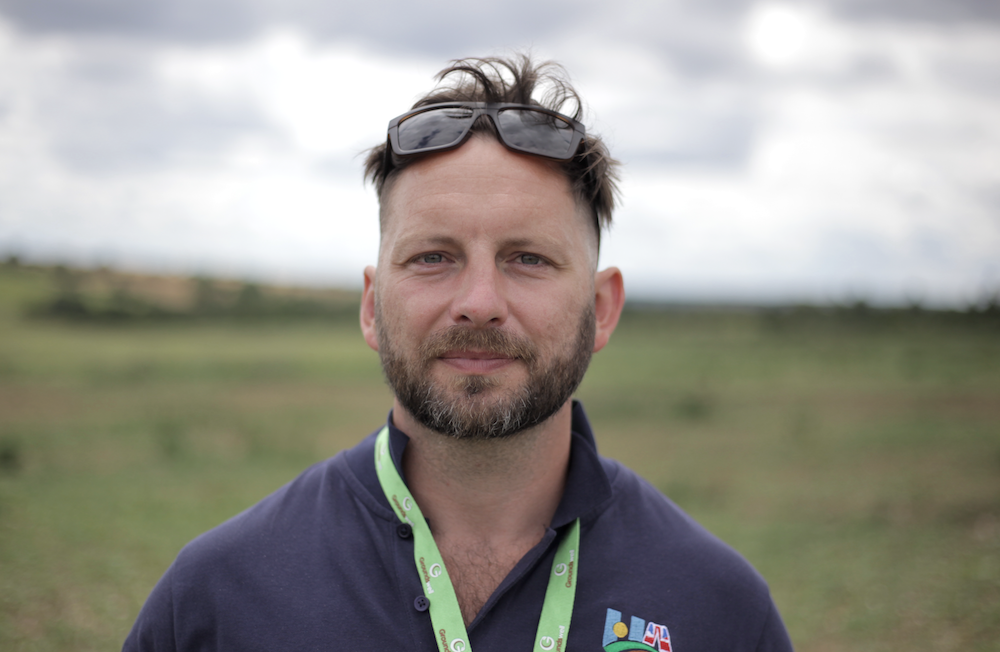
Silas Hedley-Lawrence
Over the four years the farm saw significant reductions in costs, improvements in finishing times, increased carbon sequestration in the soil and a growth in biodiversity and wildlife.
“We basically saved as much as £30,000 just on the housing cost and we were getting things done six months faster and we weren't spending any money on feed inputs. The margin increased massively,” says Silas.
“It really showed that you can farm for biodiversity outcomes and soil health and improve the economics and the efficiency of enterprises at the same time.
Working with Regenerate Outcomes to build profitable, resilient farms
Silas was so enthused by the potential of regenerative agriculture that he made the move to set up his own consultancy business.
He completed the CREATE programme with Nicole Masters in Yellowstone, in the United States, in 2024, as well as the Roots to Regeneration course with Caroline Grindrod, in the UK.
Since then he has been delivering training days for farmers and advisers whilst supporting farmers one-to-one on a diverse range of systems and enterprises across the UK but predominantly on large scale mixed farming systems.
Alongside building his consultancy business, Silas established two joint ventures in the Cotswolds, collaborating with landowners to deliver on soil health and natural capital gains, which has created the opportunity to establish his own farming business.
Silas says his approach to mentoring begins with understanding the context and goals of farmers and supporting them to make change in a way that meets their aims.
“You have to figure out what people have been doing already, what they have tried and what advice they have had and what they are trying to achieve,” he says.
“You need to have all the pieces of the puzzle there before making decisions and making suggestions. We're trying to join the dots between what good looks like and the challenges we can see and observe on the ground.
“You need to have all the pieces of the puzzle there before making decisions and making suggestions. We’re trying to join the dots between what good looks like and the challenges we can see and observe on the ground. ”
“Usually the best way to go about that is to do what I call a ‘safe to fail’ trial. Let's come up with a hypothesis and implement it at a scale where, if it all goes wrong, it doesn't scare anybody. It's not going to cost us loads of money. We're not going to lose sleep over it.
“If it works, that’s brilliant. We can have confidence to push things a bit harder and a bit faster. If it doesn’t then it shouldn’t really matter. That’s a good way to ease people into it. If it works or if it doesn’t, it’s still a good lesson.
“You can begin with those baby steps but then start bringing more and more nuance into it to really understand the tools we have in the toolbox to hit and maximise the outcomes that we want to achieve.
“It's about trying to join all the dots through the layers of our farm system; soil, plants, livestock, the human element. Generally, the more we get the ecosystem functioning, the more these things all start aligning.
“We will start to see a change in things like soil structure, aggregation and colour. That also aligns with improving infiltration rates, our pastures performing better, our livestock growth rates improving, fertility going up and making more money.
“We start hitting green lights on all sorts of different layers; soil, pasture, crops, business, ecosystem, biodiversity, insects, birds. Which metric is most important to you will depend on your context and your goals.
“I think the appealing thing about Regenerate Outcomes is that there is really no risk for the farmer. You’re going to get that mentoring and soil carbon baselining done at no extra cost.
“We’ve had a huge amount of training so we can be really versatile and get into your world and help you move the needle in the right direction. I don’t think there’s anyone offering anything nearly as comprehensive at the moment.”
Regenerate Outcomes works with
farmers to grow profits
We provide one-to-one mentoring to help you cut costs and improve crop and livestock performance.
At the same time, we baseline and measure soil carbon at no upfront cost to generate carbon credits which you can retain or sell for additional income.
Find out more by downloading our Programme Handbook.