
Grounded ‘Live’: Debunking the myths about regenerative farming
In the final recording for Grounded ‘Live’, Kyle Richardville and Stuart Johnson, from our mentoring team, discussed some of the myths and misconceptions about regenerative practices with two farmers who have adopted them in their system.
They were joined by James Johnson, from Mallard Grange, near Ripon, and Matt Griffin, farm manager at Neidpath Farms, in the Scottish Borders. Together they discussed the process of change, resilience, profit, fencing, water infrastructure, managing relationships and much more.
You can watch the full recording of the conversation below, or listen as a podcast here
Building resilience with regenerative farming practices
James runs a predominantly grassland farm in partnership with his father Charles. They farm an Angus Hereford cross suckler herd, Aberfield Highlander sheep, laying hens and a small amount of arable.
“The big turning point for us was that winter of 2019 into the spring of 2020 where you went from an unbelievably wet autumn to a ridiculously dry spring,” says James.
“The crops were struggling. You couldn't get onto the land if you wanted to get something done and the forage was dire. We were thinking ‘What we're doing here is not working, but what can we do?’”
James and Charles began researching regenerative practices on the internet and by visiting Groundswell, before experimenting on their own farm.
“We started off in one field with herbal leys. It out-yielded everything else without an ounce of fertiliser on it. So it was like, well, this is just a bit of a no-brainer,” says James.
They began managing the forage using longer rotations and introduced a direct drilling system on their arable land, with noticeable improvements to the soil structure and resilience to extreme weather.
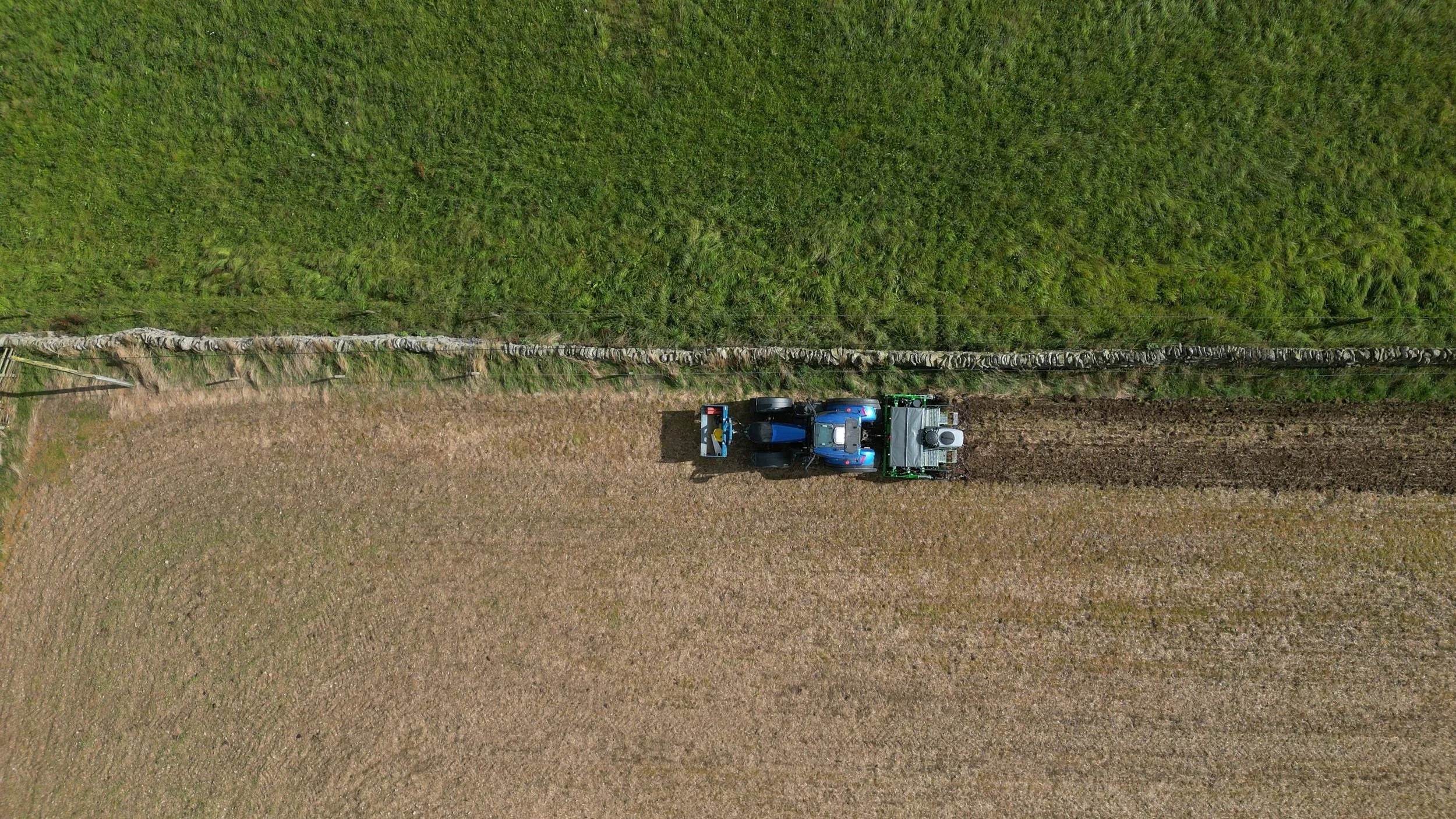
Direct drilling on a farm in Northumberland
James says although there were healthy family debates around some of the changes, the process was eased by the fact they all agreed something needed to change. They also took the approach of experimenting with new practices in smaller areas before committing on a larger scale.
“Dad always says his yields were dropping all the time when they should have been increasing. He knew something wasn’t right. There were browser hills that were losing that layer of topsoil and just needing more and more work,” says James.
“The process helped us understand each other better and I am really lucky that my family unit is tight. We can have difficult conversations but work forward and give each other opportunities.”
Making incremental changes to cut input costs
“We’re a rented farm and we always have a rent to pay at the end of the day and I think that is the most risky situation you can be in.
“We were at a point where, if we continued on the path we were on, we weren’t going to get to where we needed to be. We needed to make change but do it in a very constructive way.
“Fertiliser prices went absolutely through the roof. What do we do? Do we go and buy another load of fertiliser that tests our cash flow? Or do we go out and buy electric fencing and concentrate on trying to improve our grass management?
“The process helped us understand each other better and I am really lucky that my family unit is tight. We can have difficult conversations but work forward and give each other opportunities.”
“It started with setting a few paddocks and moving them once a week. We set everything up in stringent blocks. We bought permanent water troughs. Then you go through that stage and you gain confidence and see a difference and you make more change.”
They now use mobile fencing and move cattle as often as every 12 hours in the summer months.
“We had to go through steady increments or it would have been too much,” says James.
“Now we just want to continuously keep experimenting because we know we can. It becomes addictive. There is always something else you can try.”
Achieving clear farming objectives
Matt manages around 2500 acres with sheep and beef in the hills around Peebles and wants to challenge the assumption that upland farming cannot be profitable without subsidies.
He experienced many of the practices which are now in use at Neidpath Farms during 14 years managing sheep and beef farms in subsidy-free New Zealand. In 2018 James returned to the UK and began working for the owners who wanted to build resilience into the system through improving soil health.
“I came into a system which was ticking along and not particularly resilient and heavily reliant on inputs and subsidies,” he says.
“I wanted to try and build a system which could navigate around climatic changes and policy changes. It has been a challenge, but we are tracking in the right direction.
“We want to build resilience that allows us to weather the storms; whether that’s really wet weather, whether that’s really dry weather, we want to be able to withstand input costs going through the roof and market prices falling. ”
“We have a clear list of farming objectives. Number one is to farm profitably, without the subsidy, so that we can use the subsidy to build new enterprises to create more opportunity for other people. We want to build a business that is employing more people than when I started.
“We want to build resilience that allows us to weather the storms; whether that's really wet weather, whether that's really dry weather, we want to be able to withstand input costs going through the roof and market prices falling. We also want to be able to weather policy changes.
“We farm in a very beautiful area and we've got the iconic River Tweed running right along the edge of the property. So we also have a responsibility to put water back into the Tweed in the best state that we can.
“There is a mindset in the business that we want to fail at a few things every year. We want to really push ourselves. When anybody says to us, ‘I don't think that'll work’ that spurs us on to try.”
Regenerate Outcomes works with
farmers to grow profits
We provide one-to-one mentoring to help you cut costs and improve crop and livestock performance.
At the same time, we baseline and measure soil carbon at no upfront cost to generate carbon credits which you can retain or sell for additional income.
Find out more by downloading our Programme Handbook.